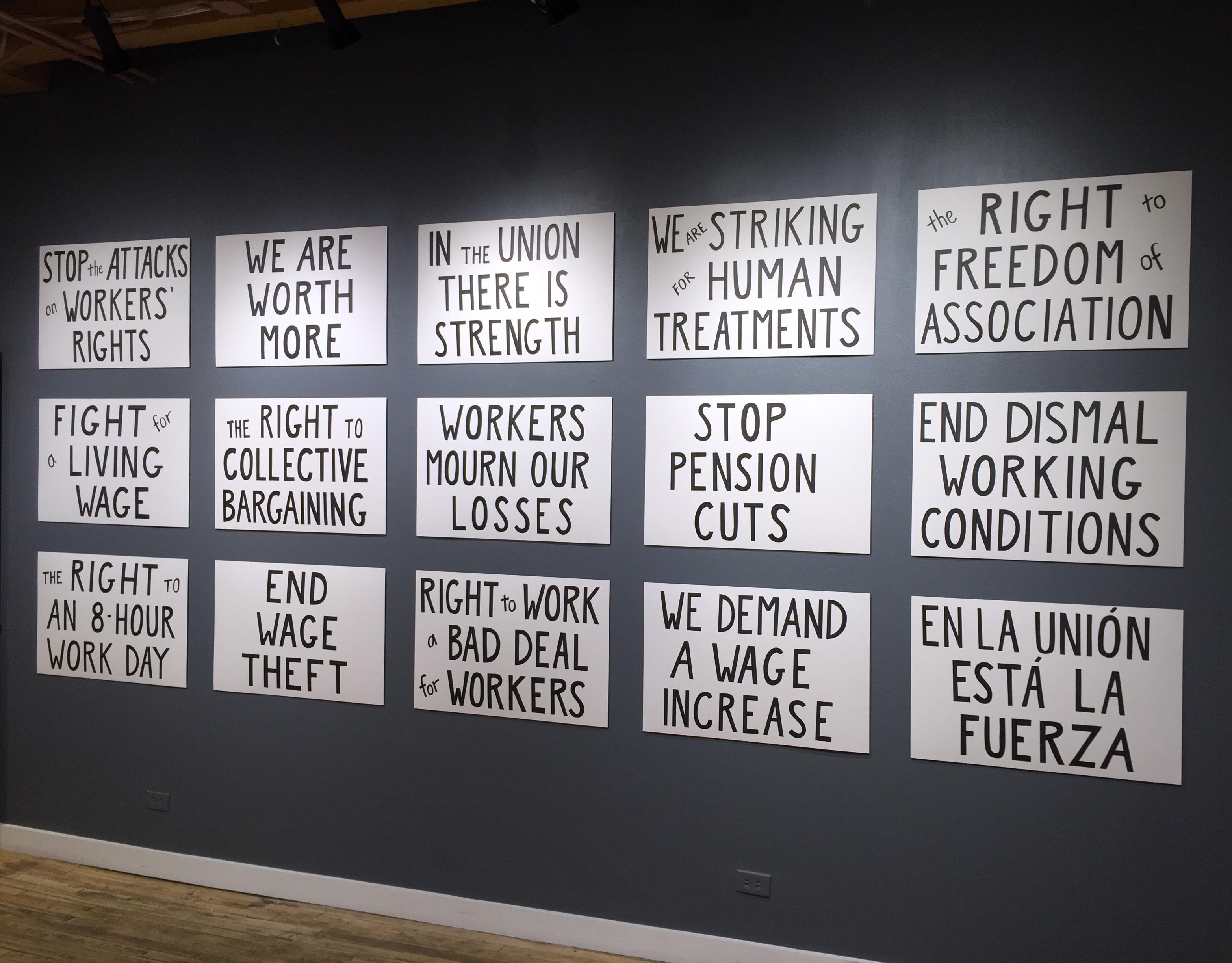
New Demands?
2015
Drawings, ink on illustration board
20 x 30 inches each
Exhibited as part of An Invisible Hand at David Weinberg Gallery, Chicago
New Demands? responds to attacks on labor protections and workers' rights. It brings historical demands for better working conditions into conversation with more contemporary losses for workers and unionized labor.
Top row, left to right:
Stop The Attacks On Workers' Rights
From protests in Wisconsin against the unilateral ending of collective bargaining rights for public sector employees, by governor Scott Walker, in March 2011
We Are Worth More
From the Fight for $15 movement, advocating for the minimum wage to be raised to $15 per hour. The federal minimum wage in the US is $7.25 per hour. It has not increased since 2009
In The Union There Is Strength
From the International Ladies Garment Workers Union
We Are Striking For Human Treatments
From a 1910 cloak makers' strike by women garment workers in Chicago. They demanded the same 8-hour as male workers, paid overtime, union recognition, an end to arbitrary wage reductions by abusive foremen, and clean women's restooms
The Right To Freedom Of Association
Middle row left to right:
Fight For A Living Wage
The Right To Collective Bargaining
A key historical and present-day demand by unions and workers. I also used this phrase in performances created as part of the larger series New Demands?
Workers Mourn Our Losses
From banners at a funeral march following the Triangle Factory Fire, in 1911. I also used this phrase in performances created as part of the larger series New Demands?
Stop Pension Cuts
Based on the pension crisis in Illinois (and elsewhere). Public and corporate pensions are being cut back or eliminated, devastating the retirements of workers who paid into their pensions.
End Dismal Working Conditions
From the 1968 Memphis Sanitation Workers' Strike. On February 1st, 1968, garbage collectors Echol Cole and Robert Walker were crushed to death by a malfunctioning truck. Subsequently 1300 Black sanitation workers from the Memphis Department of Public Works went on strike to demand fair wages, safer conditions, and union recognition.
Bottom row, left to right:
The Right To An 8 Hour Workday
In the US, the regulated 8-hour work day became law in 1938, under the Fair Labor Standards Act. The goal of the eight-hour work day was proposed in 1817 by the Welsh social reformer Robert Owen, who coined the slogan: "Eight hours' labour, Eight hours' recreation, Eight hours' rest".
End Wage Theft
With and without laws that prohibit the practice,
Workers are at risk of having their wages, tips, and overtime pay stolen by their employers, even when laws exist to prevent wage theft. Ending illegal wage theft is one of the most central demands by garment workers in Los Anegeles, which is the largest garment making hub in the US.
Right To Work: A Bad Deal For Workers
"Right to work" laws aim to erode and ultimately suppress union membership. In 2015 there were 22 "right to work" states. In Illinois, then governor Bruce Rauner tried to pass limited right to work laws but was unsuccessful.
We Demand A Wage Increase
En La Union Esta La Fuerza
Spanish version of "In The Union There Is Strength."