Pages from "New Demands? Part 1"
Counter Signals 2 (2017): 50-69
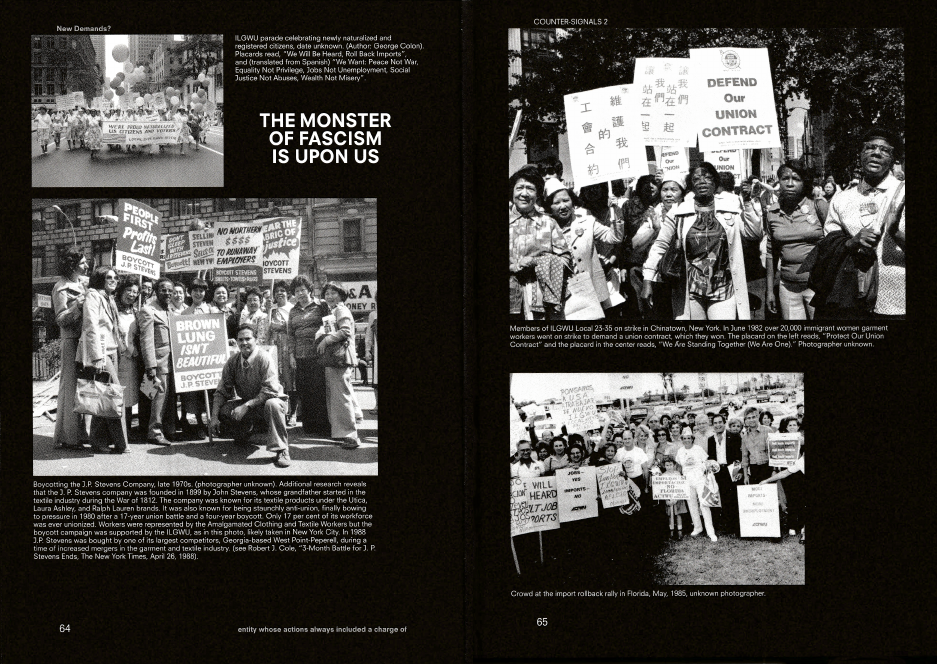
This hybrid research/visual essay combines archival photographs and contextual writing to create a visual narrative of key moments in the history of the International Ladies Garment Workers Union and by extension, the history of labor organizing in the garment industry.
Using historical photographs taken at strikes, protests, rallies, and campaigns organized by the Union, the essay creates a visual narrative of the Union's demands, victories, and losses spanning 1910–1985. Readers will see visual evidence of some of the most historically significant victories for garment workers, like the rights to unionize and to collective bargaining, minimum hourly wages, a regulated workday and workweek, overtime and vacation pay, and pension benefits, among others. Readers will also observe a decline in the Union's bargaining power and the loss of thousands of union jobs because of neoliberal trade policies and multinational concentration in the industry. By the 1980s, the Union battled to maintain its contracts and agreements with manufacturers, and its campaigns urged consumers to buy union-made clothing produced in the USA instead of cheap imports. By the mid-1990s, many garment workers in the US were struggling with many of the same exploitative working conditions as in 1909.
The essay also foregrounds some of the archival research and historical source materials that inform my works in print, vinyl, neon, textiles, and drawings, created as part of the series New Demands? Many of the works use text and demands that are cited or adapted from campaigns waged by the International Ladies Garment Workers Union, as illustrated on the pages of the essay. The essay mirrors a series of print works created in 2015-2016, using many of the same archival photos and materials.
Research was conducted at the International Ladies' Garment Workers' Union archives at the Kheel Center for Labor-Management Documentation & Archives, Cornell University.
All images courtesy the Kheel Center at Cornell University.
Layout and design by Jack Henrie Fisher