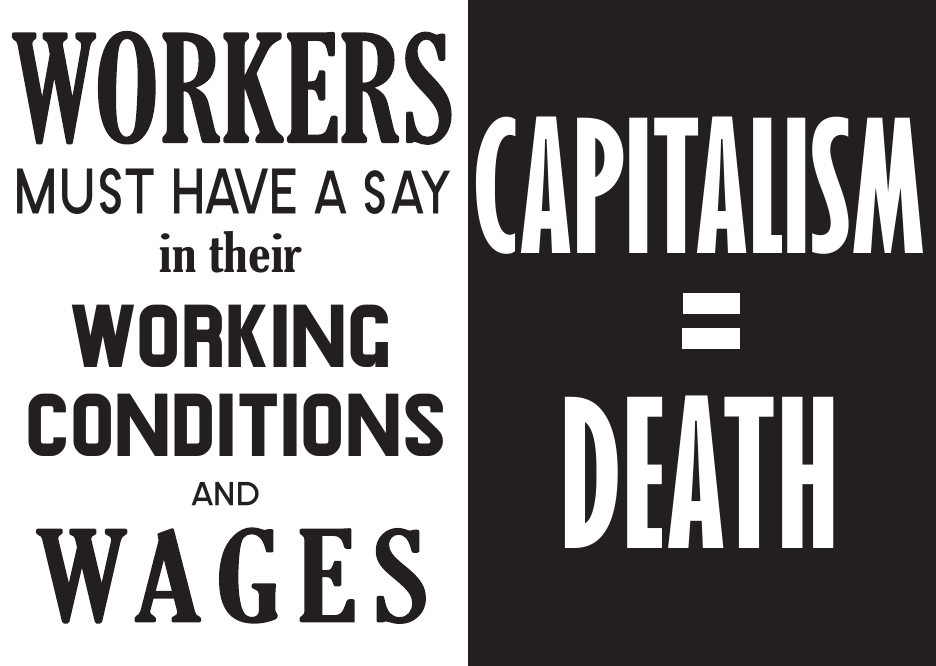
Workers Must Have A Say In Their Working Conditions And Wages
2021
Capitalism = Death
2021
Facing pages from "New Demands? Part 2"
Counter Signals 4 (2021): 68–89
9 x 13 inches
Workers Must Have A Say In Their Working Conditions And Wages
Quoted from the Make LA Sweatshop Free campaign, organized by the Los Angeles Garment Worker Center / El Centro de Trabajadores de Costura: "To address the egregious conditions in the LA garment industry, the Garment Worker Center launched its MAKE LA SWEATFREE platform. Garment workers must have a say in their working conditions and wages by having the right to negotiate directly with employers and the brands that profit from their work".
The Garment Worker Center is a worker rights organization whose mission is to organize low-wage garment workers in Los Angeles in the fight for social and economic justice. It is at the forefront of struggles for change in Los Angeles' garment industry, which is the largest in the US.
https://garmentworkercenter.org/make-la-sweatfree/
Capitalism = Death Inspired by the iconic SILENCE=DEATH poster, which features a pink triangle as a symbol for the persecution of LGBTQ communities. The SILENCE=DEATH poster was created in 1986 by members of the Silence=Death Project: Avram Finkelstein, Brian Howard, Oliver Johnston, Charles Kreloff, and Chris Li. It was adopted by the AIDS Coalition to Unleash Power, ACT UP. The poster became a visual symbol of AIDS activism in the 1980s and 1990s, when tens of thousands of gay men perished unnecessarily as a result of the callous homophobia and willing lack of national action by Reagan and Bush administrations. Decades later, the Covid-19 pandemic was especially deadly in low-income, BIPOC, and rural communities in the US, where people are more likely to hold low-waged jobs and/or lack adequate health insurance. In contrast, the wealth of the richest Americans and American corporations skyrocketed exponentially during the pandemic, often by billions of dollars.
"New Demands? Part II" is a hybrid research/visual essay. It combines text-based artworks from my ongoing series New Demands? with contextual research and writing on historical and present-day exploitative working conditions in the garment industry, the gig economy, and academia. Some of the art works (like this one) were created for the essay; other are reproductions or re-interpretations of prior works created and exhibited under the larger framework of New Demands?